
How Bench Warrants Work in Ector County
A bench or failure-to-appear warrant is court process tied to an existing case. In Ector County, a missed setting, failure to follow a court order, contempt, or failure to meet a show-cause requirement can bring the matter back before a judge. The issuing court, rather than a countywide list, is the right place to confirm the record.
Family or child-support matters may be kept with district or family-court records. Odessa citations have a city-court deadline and separate local procedures. A post-judgment fine is different: the court may issue a capias pro fine, or CPF, with hardship and payment safeguards under Texas law.
Four Ector County JP Courts Keep Separate Warrants
The four Justice of the Peace precincts share Room 208 at 300 North Grant Avenue, but each has its own docket and direct phone line. Precinct 1 is 432-498-4201, Precinct 2 is 432-498-4202, Precinct 3 is 432-498-4203, and Precinct 4 is 432-498-4204. A traffic citation should identify the right precinct.
Ask that court whether the matter is still a balance, an FTA, a bench warrant, or a CPF. A general payment link can show an amount without resolving the court’s appearance requirement. The Precinct 4 page illustrates the local court contact route.
The county’s JP Precinct 4 page identifies a lower-court office, not a countywide warrant counter.
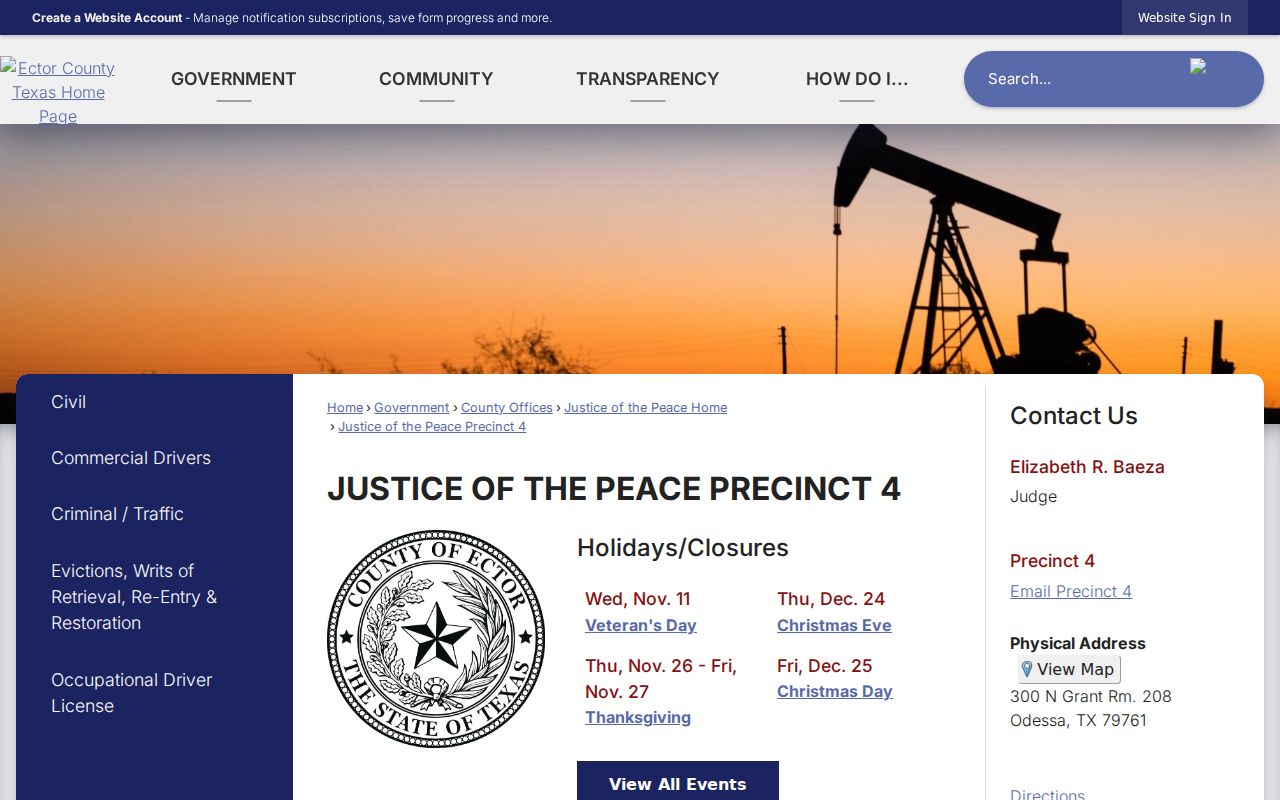
Call the precinct named on the citation and keep its instruction with the case paperwork.
Bench Warrant Issuance in Ector County
The judge in the underlying case decides whether to issue process after a missed setting or other court-order problem. The record may remain with a district court, County Court at Law, JP precinct, or Odessa Municipal Court. It is not safe to assume that every lower-court warrant rolls into the Sheriff’s records or the county index.
Texas law requires notice before certain initial-appearance FTA warrants in justice and municipal court cases. The exact Ector notice method or a common grace period was not found for every court. Ask the clerk whether notice was sent, whether the case can be reset, and whether the judge must hear a request.
Ector County Bench Warrant Status Needs Clerk Confirmation
Odessa’s public docket shows calendar labels such as BENCH, pretrial, indigent, and arraignment. A BENCH label identifies a docket type, not a complete public roster or proof that a warrant remains active. The Ector court portal is also an index and docket tool, not a single live status system.
When a case appears, ask the clerk whether the warrant is selected but not signed, signed and active, served, recalled, or connected to another court order. Keep the case number and date of the clerk’s answer. The research did not locate one countywide status vocabulary or a uniform update cadence.
How Bench and Arrest Warrants Differ
The key difference is what led to the court order. A bench warrant follows a court appearance or compliance problem; an arrest warrant is based on the statutory probable-cause process for an alleged offense. Both may authorize an arrest, but they connect to different events and questions for the issuing court.
| Feature | Bench Warrant | Arrest Warrant |
|---|---|---|
| Trigger | Missed setting, order, or contempt issue | Sworn probable-cause basis for an offense |
| Record | Existing case and court event | Offense and magistrate order |
| Likely Ector venue | District, county, JP, or municipal court | Magistrate with jurisdiction over the offense |
| Next question | Reset, hearing, bond, or recall path | Issuing court, bond, counsel, and appearance |
CPF Is a Separate Ector Court Track
A capias pro fine follows a judgment and unpaid fines or costs; it is not just another name for a missed first appearance. In Odessa, the 2026 standing orders say the defendant is brought before the issuing court, where the magistrate may consider ability to pay, hardship, indigency, a payment period, bond, release, or credit for time served under the order.
For a JP case, call the precinct named on the ticket and ask whether the status is FTA, bench warrant, or CPF. A payment balance alone does not explain whether a judge appearance is required. Texas Code of Criminal Procedure Chapter 45A provides justice and municipal court procedures and safeguards for unpaid fine cases.
Clearing a Bench Warrant in Ector County
Call the court before going to a counter. Ask whether the warrant is signed, whether bond is set, whether a reset or show-cause hearing is available, and whether counsel should contact the court first. The Sheriff Warrant Division can confirm county-held process, but only the issuing court can decide how its case resumes.
- Use the ticket, court index, or Sheriff Warrant Division to identify the issuing court.
- Ask the clerk which options apply: reset, show-cause request, bond, payment, or attorney motion.
- For Odessa, ask about voluntary appearance under Safe Harbor at 201 North Grant.
- Keep a receipt or order and confirm the next date and any remaining case duty.
The Ector County Bail Bond Board publishes board and licensed-company information; it does not confirm a person's bond amount or whether a specific company will accept a case.
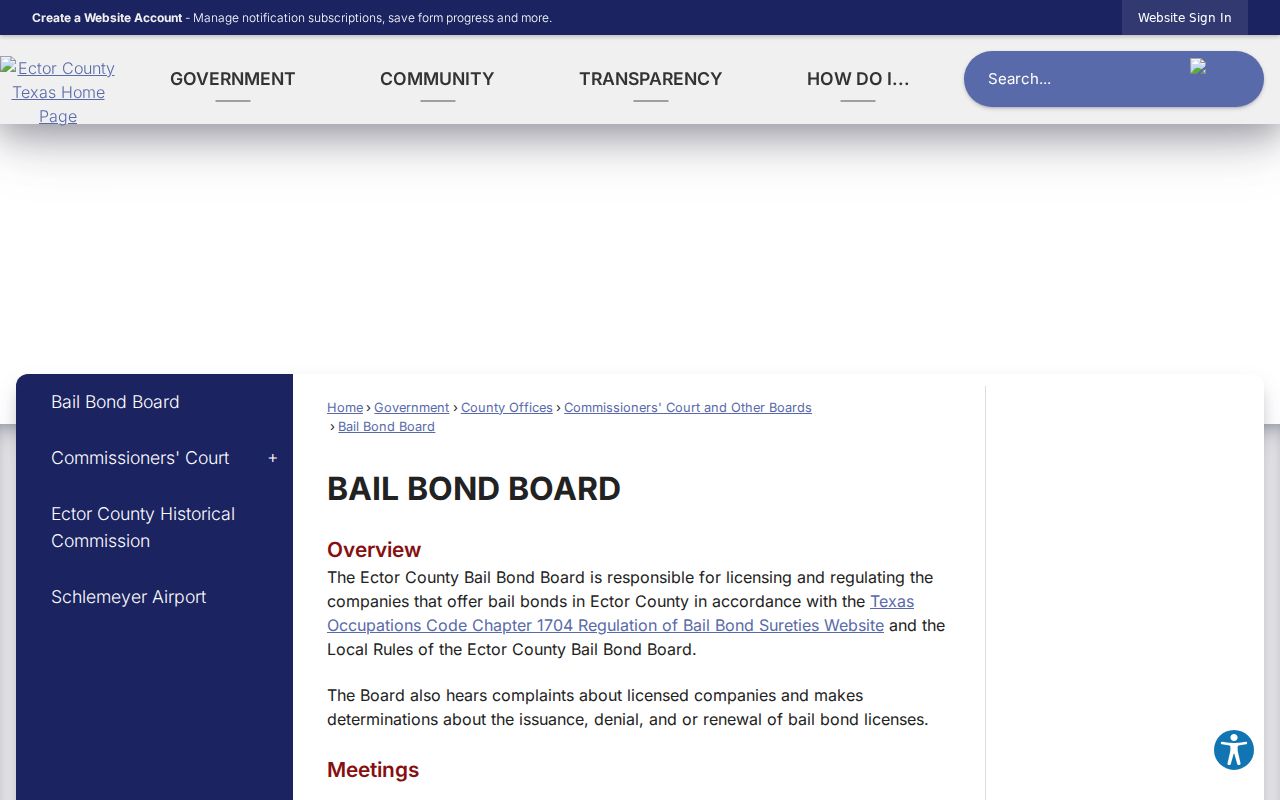
Ask the issuing court for the bond terms that apply to the warrant before making arrangements.
Caution: Do not assume an old or missing online entry has expired; ask the issuing court to confirm current status before you act.
Odessa Safe Harbor Protects a Voluntary Court Visit
Odessa Municipal Court’s 2026 Standing Order No. 7 says a person will not be arrested there on an Odessa warrant or CPF when the person voluntarily appears. The court recalls the warrant and sends notice to Odessa Police and other applicable law-enforcement agencies. This applies to Odessa Municipal Court process, not every Ector County bench warrant.
Depending on the case, the order describes a show-cause request, a signed payment plan, community-service request, clerk recall after a guilty or no-contest plea, or a bond. One prior-arrangement scenario requires a $50 down payment. Ask the court what applies before choosing a plea or payment path because the underlying case may continue.
Ector County Courts That Issue Bench Warrants
District-level cases route through one of five district courts and the District Clerk at 432-498-4290. County Court at Law and No. 2 have separate criminal contacts at 432-498-4110 and 432-498-4120. A JP citation belongs to one of four precincts; an Odessa city citation belongs with Odessa Municipal Court at 432-335-3300.
The Ector County warrant check page explains how to use the public index and local phone routes. For a federal or out-of-state hold, ask which outside agency controls it; a county clerk cannot recall a warrant issued elsewhere.
County Court, JP, and City Files Stay Distinct
The courthouse at 300 North Grant groups several offices but does not merge their records. The District Clerk is in Room 301; the County Courts at Law are in Rooms 234 and 235; the JP offices share Room 208. Odessa Municipal Court is nearby at 201 North Grant and uses its own case portal and standing orders.
Ask which clerk owns the case rather than sending a recall request to a general counter. The County Courts at Law page provides the two court contacts. A request by email may help locate information, but the District Clerk says formal filings cannot be accepted by fax or email.
The Western District office-locations page identifies the Midland/Odessa federal division for outside federal matters.
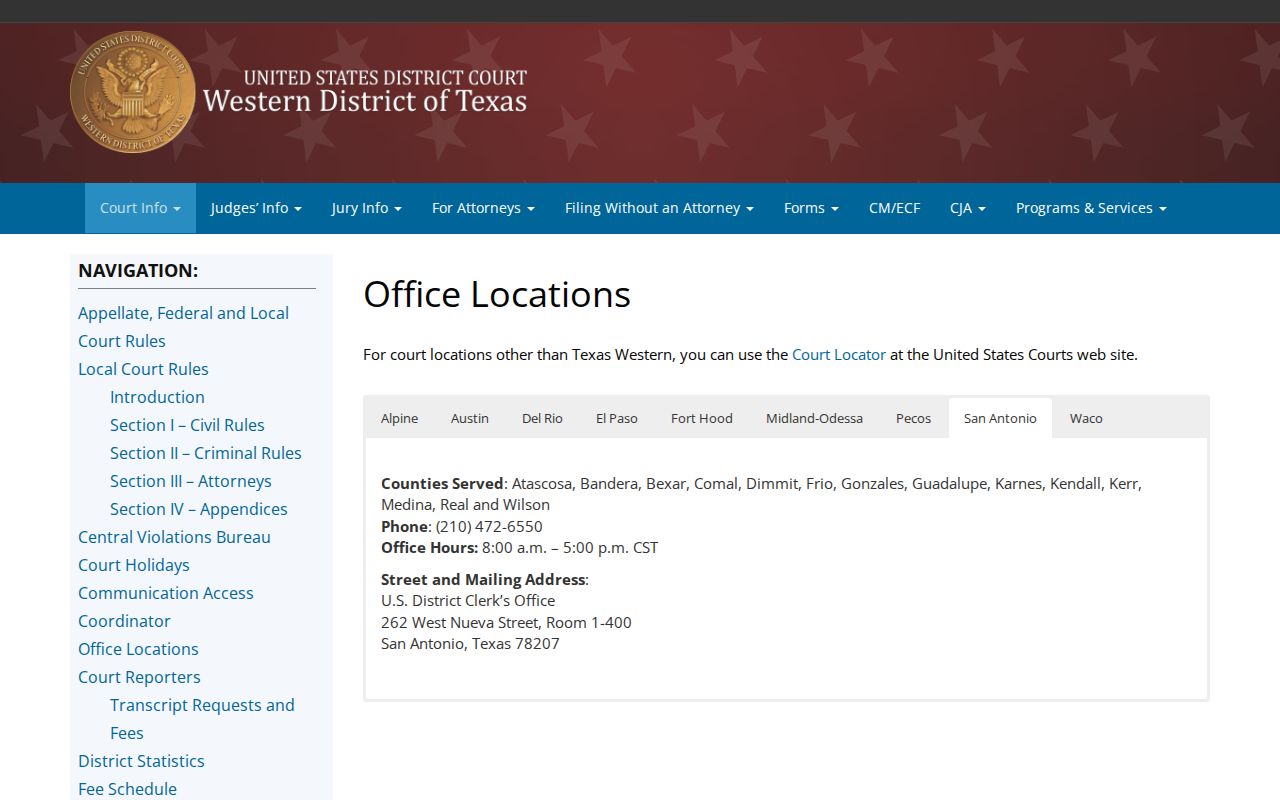
A federal venue remains separate from the county and municipal courts described above.